





Eye For Film >> Movies >> Red Riding (2026) Film Review


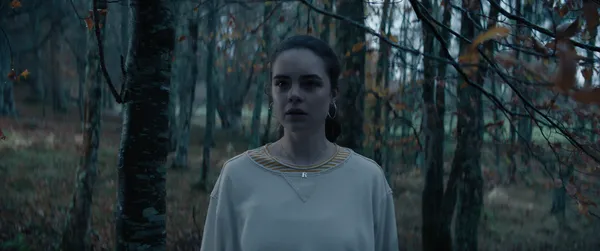

One of the fairy tales most frequently adapted for film, Little Red Riding Hood is a difficult one to get right, its vivid psychosexual undercurrents too much for some unwary writers and directors to handle. This Glasgow Frightfest pick starts out well with a bitter slice of social realism as young heroine Redele (Victoria Tait) loses her mother to drug addiction. With nowhere else to go, she’s packed off to stay with the dead woman’s own estranged mother, Penelope (Lynsey Beauchamp), a Scottish aristocrat with a spacious house and heavily wooded estate in the middle of nowhere. There’s little for the teenager to do, which immediately makes it feel like a bad idea, as she clearly needs to process her grief. Though an old bicycle is found to give her some freedom, she is strictly advised to stick to the road and never stray in among the trees.
Deeply buried family secrets haunt this place, and it soon emerges that Redele’s mother was not the only one to flee from or be rejected by the family. An old telephone box in the local village is plastered with posters about missing children. Something lupine runs in the woods. When Redele inadvertently upsets Penelope, she discovers another side to her gracious host and realises that aristocratic families have horrors of their own. As she struggles to deal with the situation, on unfamiliar territory and short of allies, she begins to see her mother in a new light. Perhaps there was a reason why she sought relief in drugs. Perhaps they were not so different after all.

A first stab at directing for actor Craig Conway, Red Riding scores high on atmosphere and is grounded by a strong central performance. Its problems lie mostly with Peter Stylianou’s script, which tries to pack in too much in a manner that leaves scenes feeling disconnected and sometimes upsets the pace. Expecting the audience to take seriously a character called Lady Penelope (not a very Scottish name to begin with) is daft, and an annoying distraction. There are also idea around the missing children which are never fully developed, making one wonder if an editor (of either the literary or film variety) has pared it back in the wrong places.
The whole thing looks great, making confident use of the landscape and stitching together a handful of rooms well enough to tell the story of the house. Conway has a fluid directorial style which moves easily between action and dramatic scenes, a rarer talent than you might think. He also adjusts well between the big dramatic scenes in the mansion and more down-to-earth scenes in the village, which is refreshingly free of mumbling peasants and instead presents a fairly mundane slice of Scottish rural life, albeit with a bit of petty crime in the mix.
Positioning this commonplace criminal behaviour from people who are basically decent, just seeking to expand the possibilities of impoverished lives, alongside the impunity assumed by the wealthy provides a bit of political comment but also highlights Redele’s vulnerability – she may have known how to look after herself in London, but she’s in a different world now. Just how different is established by an ending which abruptly shifts gears, setting aside her tough rationality for something altogether more animalistic, and deliriously shot. it’s a nice touch which elevates the whole and will help it to stick in the memory, no matter how many other red-caped girls you see walking though the trees.
Reviewed on: 08 Mar 2026


